
Research showcase
IssyOsborne: transIentSqueeze and Starvation in elastohydrodynamic — OScillating Bodies sOlving Reynolds oNe-dimensional Equation
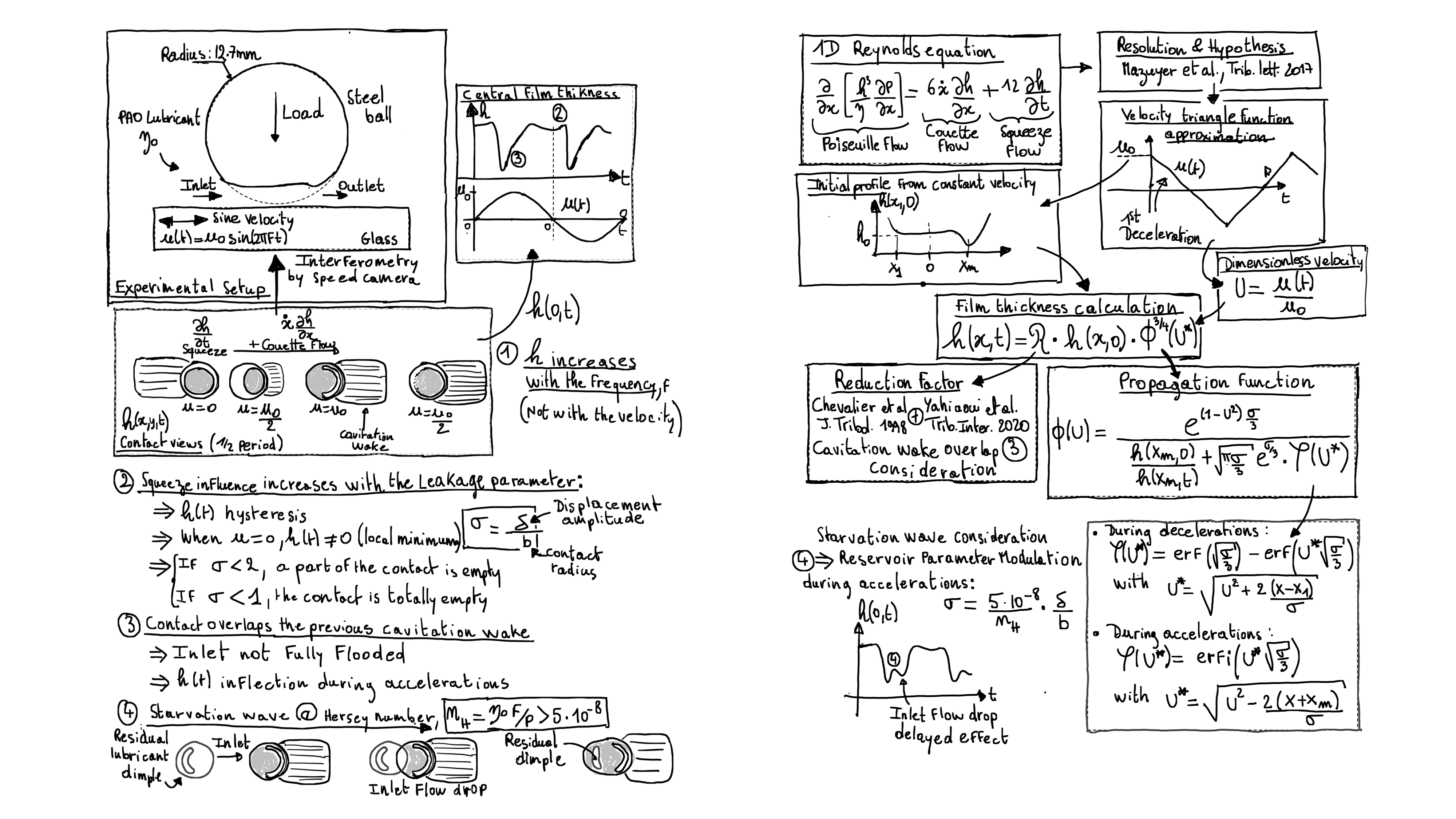
In the field of tribology, many applications operate in the elastohydrodynamic lubrication (EHL) regime e.g., automotive engines, gears and rolling element bearings. In the EHL regime hydrodynamic performances are significantly enhanced by the contact bodies elastic deformations and the lubricant piezoviscosity. IssyOsborne is a procedure package for Igor Pro designed to be used by researchers in the field of tribology and fluid mechanics. It allows to easily calculate the film thickness distribution in lubricated sliding contact in EHL regime under time-varying conditions. This calculation is performed given the contact conditions, the fluid properties and the contact bodies properties. IssyOsborne can be used for deceleration, acceleration and reciprocating motions. In the algorithm, a full-analytical resolution of the Reynolds equation was derived. Validated experimentally, the analytical film thickness equations perfectly modeled the mechanisms behind film formation, such as squeeze due to the transient evolution of the film thickness over time, asymmetry and hysteresis in film distribution.
Keywords: Elastohydrodynamic lubrication, Reynolds equation resolution, Reciprocating sliding, Transient flow
Acoustic emission characterization of transgranular cracks in WC-Co cemented carbides during a one way scratch
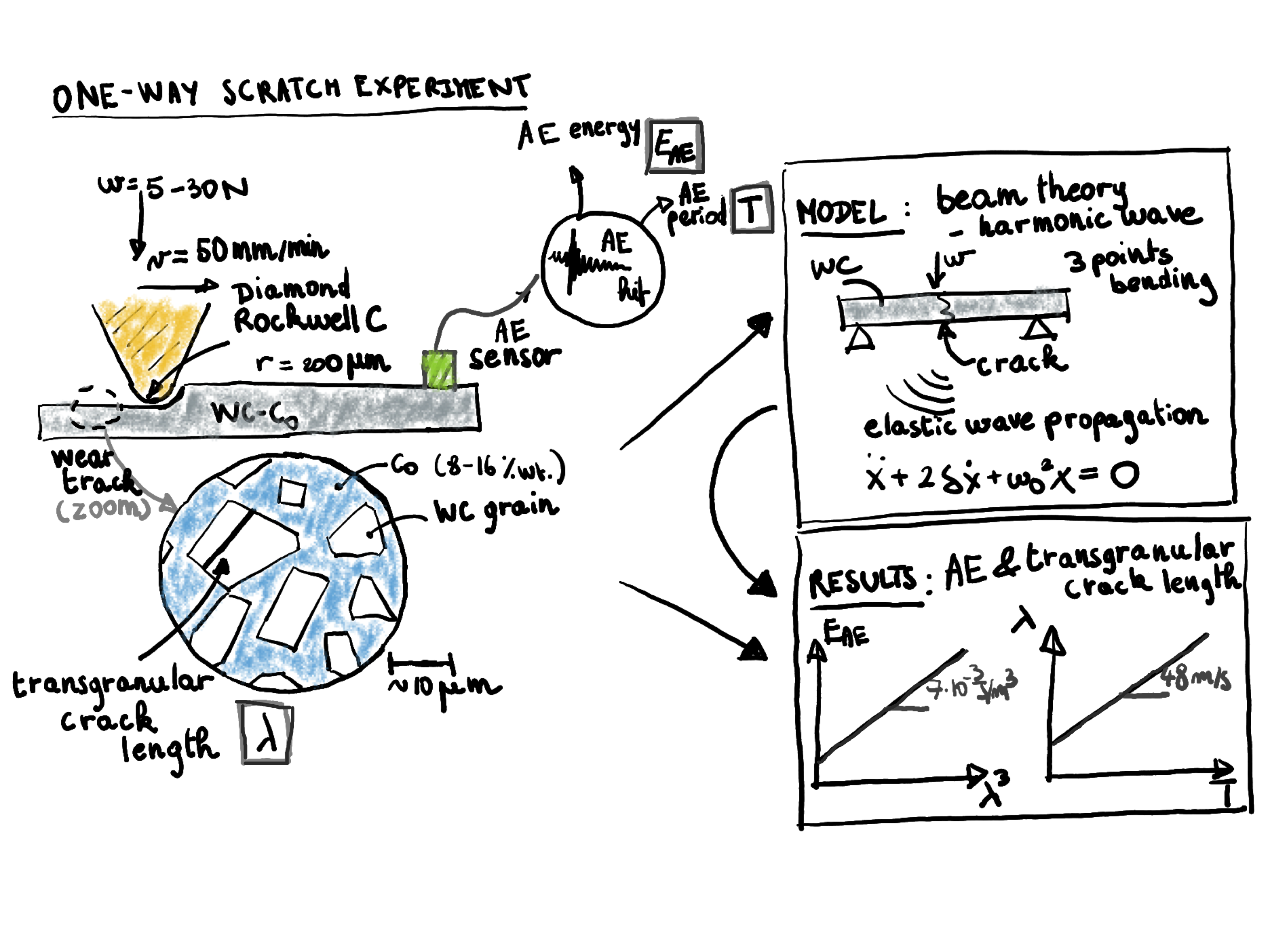 The tribological behavior of tungsten carbide-cobalt materials is influenced by the cobalt content and the WC grains size. The main wear mechanisms in these materials are cobalt depletion, intergranular cracks and WC grain cleavages. More specifically, coarse WC grains favor the apparition of transgranular cracks during sliding friction tests. A promising way to access in real time blinded tribological contacts is the technique of acoustic emission (AE). This study clearly identifies transgranular cracks in AE signals. The AE energy and frequency of this mechanism were experimentally associated with the size of the transgranular cracks. A mechanical model based on the classical beam theory and harmonic motion equations confirms these relations. The AE centroid period (i.e. inverse of the centroid frequency) increases linearly with the size of the transgranular cracks. The AE energy increases linearly with the cube of the transgranular cracks length.
Keywords: Acoustic emission, WC-Co, Friction, Transgranular crack, Beam theory, Harmonic motion